How massage helped Bobby
Canine massage therapy is an effective treatment for muscular issues in dogs such as tears in the muscle otherwise known as muscular strains. It can also help to support the management of long term orthopaedic conditions such as hip or elbow dysplasia or arthritis.
Below, Canine Massage Therapist, Sam Axtell explains how canine massage helped Bobby.
Degenerative Joint Disease: Elbow Dysplasia
Bobby is a seven year old black Labrador. Unfortunately poor Bobby suffers from a degenerative joint disease, elbow dysplasia, affecting both elbows with the vet estimating that the joint in his left elbow is so inflamed the temperature is probably at about 70-80 degrees centigrade.
Bobby struggles to walk and when he does he has very ungainly gait. But Bobby is fortunate to live with his family. They make sure that Bobby has gold standard healthcare and when he heard about canine massage they contacted me to see if I could help.
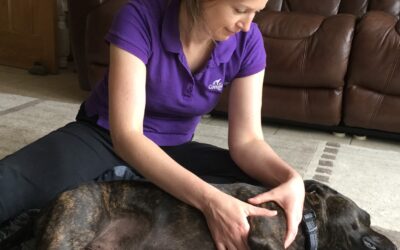
The first thing I noticed when I assessed Bobby was just how hard his muscles were. This is known as the muscles being hypertonic. Often people think that hard muscles are strong healthy muscles but when they become excessively hard they can begin to cause a problem. This is because blood flows through muscles, passing through and around the endless number of fibres that make up an individual muscle. This blood provides essential oxygen and nutrients and aids in the removal of toxins, carbon dioxide and metabolic waste. Hard muscle impedes the flow of this very lifeblood causing the muscles to become congested and sore.
So my first job with Bobby was to begin to warm and soften those muscles to begin to relieve his obvious discomfort.

Photo’s by Dave Finchett Photography
Bobby also had a condition called Myofascial Pain right across his body, particularly on his left hand side. This was affecting the hamstrings and quadriceps in his hind legs, right across his back and across his ribs. Myofascial Pain Syndrome is a chronic pain disorder affecting the fascia (connective tissue found throughout the body). Most dogs experience muscle pain that generally goes away in a few days.
Dogs with myofascial pain syndrome have pain symptoms that persist or worsen. More than likely Bobby was experiencing:
- Deep, aching pain in his muscles, worsening over time
- Muscle stiffness
- Joint stiffness near the affected muscle
- Painful tight knots in his muscles
- Difficulty sleeping due to pain
This condition called for an approach including myofascial and deep tissue techniques, releasing those tight painful muscles so they could regain their flexibility and mobility. I’m pleased to say that after three massage treatments over the course of three weeks, Bobby showed a great improvement.
Bobby’s owner said
“Even after his first treatment, people that we met on our regular walks were commenting on how much better he was moving. His lameness was reduced and he just seemed to be happier. He had a real spring in his step. Sam warned me that this might happen but after each treatment Bobby would have a mad five minutes. It was obvious to me that he felt so much better.”
Author: Sam Axtel