LUXATING PATELLA – IS IT A GRADE 1, 2, 3 OR 4?
What is Luxating Patella? – Also known as subluxation of the patella or trick knee
Luxating means ‘to dislocate’ or ‘put out of joint’. The patella is the kneecap; therefore luxating patella is dislocation of the knee cap from its normal position.
Let’s have a look at the anatomy of a knee joint (stifle joint in dogs) 
Images taken and adapted from:
https://www.doghealth.com/health/arthritis-and-lameness/2200-luxating-patella-in-dogs
The patella is a small piece of bone located within the quadriceps tendon of the knee. The top of the patella attaches to the quadriceps (thigh muscles) via the quadriceps tendon and the bottom of the patella attaches to the tibia (shin bone) via the patellar tendon also known as the patellar ligament. The patella plays a central role in extension and flexion of the knee joint; however it can only do this if it remains in its normal position.
For the patella to remain in its normal position it should slide within a groove at the end of the femur (thigh bone), called the trochlea groove. When it moves out of this groove it is said to be dislocated or luxated. The patella can luxate either medially (to the inside) or laterally (to the outside). Medial dislocation is more common and especially in smaller to medium dogs. Larger dogs tend to suffer with dislocation laterally.
Why does Luxating Patella occur?
- If the trochlea groove that the patella sits in is not deep enough or is damaged then the patella is more likely to luxate on a regular basis. A shallow trochlea groove tends to be a genetic issue.
- Misalignment of the hind limb can be caused through genetics or through injury. Bowlegged dogs such as the Dachshund and the Bassett Hound are examples of dogs that have misaligned structures of the hind limb where the femur and tibia are abnormally shaped. These abnormally shaped bones cause the quadriceps to continually pull the patella out of the trochlea groove; resulting in luxating patella.
- An injury to the stifle such as a cranial cruciate ligament rupture can also sometimes be connected to the patella luxating due to the redistribution of forces through the knee, likewise luxating patella can also lead to cranial cruciate ligament injury.
- Activities of daily living (ADL’s) such as walking on slippery surfaces (laminate flooring) or a dog that continually stands on their hind legs will result in tightening/shortening of the quadriceps, which then puts an unnecessary pull on the patella, leading to luxation.
- If there is an issue or pre-existing condition with the joint above the stifle (hip joint) or the joint below the stifle (hock joint), this may also lead to misalignment within the hind limb resulting in luxation of the patella.

Onset and Symptoms
Luxating patella is usually visible in puppies aged 4 months onwards, however if the condition is caused by an injury then onset can be at any age. It can affect one or both hind limbs.
One of the first signs of the condition is that your dog may appear to be hopping or skipping on the affected hind leg when active. There may not be any signs of pain when this happens and then soon after normal activity will resume.
This hopping or skipping may happen periodically or on a regular basis. Other initial signs of luxating patella are that your dog may yelp momentarily as the patella dislocates but then does not show any pain thereafter and there may be clicking sound as the patella moves in and out of the trochlea groove.
Your dog may hold its leg up to relax the quadriceps so that the patella will relocate into the trochlea groove on its own. They may also extend their leg backwards and be unable to flex the leg back to its normal position.
If the patella is continually being dislocated and relocated, it can damage the cartilage and bones within the stifle joint which will increase the chance of further dislocation. The more time the patella stays out of the trochlea groove the shallower the trochlea groove will become. This then may lead to osteoarthritis and unnecessary strain on other ligaments within the knee such as the cranial cruciate ligament as mentioned earlier.
If other damage to the joint is present i.e. osteoarthritis or cranial crucial ligament damage then there may also be swelling, lameness, lack of mobility and pain.
Diagnosis
This is always done by a Veterinary surgeon who will examine and manipulate the affected limb or limbs in the first instance and watch the way that your dog walks. Show the vet a video of the way that your dog is walking if you have one, especially if your dog does not show symptoms all of the time. Your vet may also complete X-Rays, MRI or CT scans to confirm diagnosis, identify the cause and the severity of the luxation.
The severity of the luxation is graded as below:
Grade 1 – Patella dislocates and relocates quickly or can only be dislocated with slight manual pressure – least severe grade.
Grade 2 – Patella dislocated on a flexed leg and does not relocate until the leg is extended.
Grade 3 – Almost permanent dislocation of the patella and when relocated it dislocates again very quickly.
Grade 4 – Permanent dislocation of the patella and will not stay relocated, this is the most severe grade.
Treatment and Recovery
If your dog is diagnosed with Grade 3 or Grade 4 luxating patella then surgery is usually the best option, however there are exceptions to this. Not treating severe cases especially in younger dogs will lead to further issues long term. Grade 1 and Grade 2 luxating patella can be treated conservatively. A combination of one, some or all of the below can be really effective and prevent or postpone the need for surgery:
- Clinical Canine Massage with your local Canine Massage Guild Therapist
- Medication (anti inflammatory)
- Modified exercise and ADL’s
- Physiotherapy
- Hydrotherapy
- Acupuncture
- Weight Management
- Joint Supplements
- The use of a specifically designed stifle brace
If surgery is decided as the best option for your dog by you and your vet, then there are different types of surgery that can be performed. The aim of any treatment is to ensure the correct alignment of the quadriceps relative to the hind limb.
- Recession Sulcoplasty/Trochlea Deepening Surgery – This is where a wedge of bone and or cartilage is removed from the trochlea groove and the base of it is deepened before the wedge is replaced. The result is that the patella is then able to sit safely in the deepened trochlea groove preventing the luxation.
- Femoral Varus Osteotomy – This involves straightening the femur (thigh bone) by removing parts of the bone and realigning it, fixing it with screws and plates. The now aligned limb allows the patella to glide in the trochlea groove without luxating. This is normally the preferred surgery for larger dogs or severe cases of luxating patella.
- Tibial Tuberosity Transposition/Quadriceps Realignment Surgery – The patella tendon is detached from the tibia with a piece of bone from the tibia taken with it. This piece of bone is then attached to a different part of the tibia, reattaching and realigning the whole tendon. This also realigns the quadriceps and the patella over the trochlea groove thus preventing luxation.
- Soft Tissue Reconstruction – The tissues either side of the stifle joint are likely to be too tight or too loose as a result of the luxation of the patella. These tissues can be tightened or loosened with surgery so that correct alignment is ensured long term.
The prognosis for luxating patella is generally very good, depending on the severity, cause, other ongoing issues and early diagnosis and treatment. There is a likelihood of osteoarthritis of some degree over time but the earlier that this condition is identified and treated the better the prognosis.
How Clinical Canine Massage Can Help.
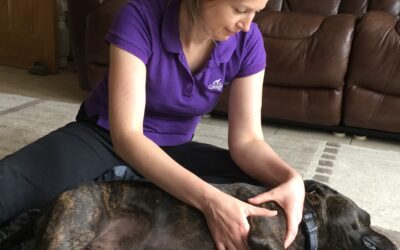
Muscle splinting is common whenever there is an injury or condition to your dog’s musculoskeletal system. It is the body’s natural way to protect an injury and enables the body to continue to function to some degree. Likely muscle splinting areas with luxating patella are with the hamstrings, sartorius and spinal muscles. Your dog may alter their gait to take pressure off their quadriceps. A Canine Massage Guild Therapist will look at all the information that your vet has provided, talk to you about your dog’s history and ADLs, observe their gait and then use palpation to identify possible areas of muscle dysfunction.
Clinical Canine Massage can be really effective with Grade 1 and 2 cases of luxating patella.
It can help to prevent or postpone the need for surgery by:
- Improving gait
- Improving mobility
- Reducing pain
- Relaxing and lengthening tight and shortened muscles, specifically the quadriceps and those identified above involved in muscle splinting and or overcompensation.
- Loosening adhered tissues, allowing the quadriceps to relax and realign which in turn enables the patella to track normally and slide correctly within the trochlea groove again.
- Helping your dog to return to normal or adapted exercise again.
- Helping to restore muscle tone and function to surrounding tissues which assist with stabilisation.
- Assisting with recovery after surgery in more severe cases of luxating patella
No more pain for Fern!
 Below is a quote from Yvette after her dog Fern, a 2 year old Poodle Cross with bilateral Grade 1 luxating patella received treatment from a Canine Massage Guild Therapist.
“Earlier this year my rescue poodle was diagnosed with bilateral Grade 1 Luxating Patella which would cause her legs to lock and her to scream in pain. She now receives regular massage from Guild therapists and has had no more incidences of her knee locking since she started this amazing treatment. As a puppy farm rescue she would not cope with being crated so surgery would have been a last resort. I now know that with regular massage this surgery may not be necessary. I cannot recommend Guild therapists highly enough, thanks for all you do”
Yvette in St Austell