
Canine Conditions
Many dog owners turn to Clinical Canine Massage in search of relief and support for their dogs. This therapy can help address a variety of conditions and our Guild Therapists are here to offer specialist care tailored to your dog’s specific needs. Click on the link to explore more about various conditions.
Cruciate Ligament Repair
D E F I N I T I O N
Cruciate ligament repair may be required if the cranial, caudal or both cruciate ligaments are damaged.
These ligaments are tough, fibrous bands of tissue connecting the Femur and Tibia. They prevent the Stifle (knee) joint over-extending or rotating, and stop the Tibia moving forward relative to the Femur (Fitzpatrick Referrals, 2023).
Depending on the severity of injury, the joint may become unstable and require repair. There are four grades of cruciate ligament injury:
- Grade 1 – A minimal sprain or tear
- Grade 2 – A partial tear
- Grade 3 – Complete rupture
- Grade 4 – Rupture with small pieces of bone being taken
Grade 1-2 sprains can improve with rest, which must be taken seriously as grade 1 can easily become grade 2 with another twist.
Grade 3-4 requires surgery (Canine Massage Therapy Centre, 2023). This is more common for dogs weighing more than 15kg as they are less likely to heal well using non-surgical management.
Those weighing less than 15kg have a better chance, however repair takes a long time and is often not completely successful. Surgical repair replaces the ligament or alters how the knee works so that the ligament is not required.
In these surgeries, the Tibia is cut and fixed into a new position (Fitzpatrick Referrals, 2023). In TPLO (Tibial Plateau Levelling Osteotomy) surgery, the abnormal slope of the Tibia is reduced while in TTA (Tibial Tuberosity Advancement) surgery, the angle of the Patella tendon is changed to reduce tibial thrust when weight-bearing on the affected joint (Pet Health Hospital, 2023).
C A U S E S
Damage to the ligaments can occur due to weakening over time, or sudden injury such as a fall or twist causing complete rupture (PDSA, 2023).
For dogs, rupture of a ligament is more likely due to long-term degeneration which can be likened to that of a rope fraying over time; or changes to the bones of the Stifle (knee) joint due to osteoarthritis.
Factors affecting degeneration include environmental and genetic. Certain breeds have a genetic predisposition to cruciate injury and although the reasons for this are not certain, many will require cruciate ligament repair on both knees while still relatively young.
Genetically predisposed breeds include Newfoundlands, Boxers, Labradors, Rottweilers and West Highland White Terriers (Fitzpatrick Referrals, 2023).
Other factors influencing cruciate ligament stability are activities that involve landing, braking and twisting such as ball chasers and frisbee, slippery floors, landing incorrectly from a jump, hormonal imbalance, obesity and trauma (Canine Massage Therapy Centre, 2023).
S Y M P T O M S
Symptoms of injury to the cruciate ligament can vary from a slight limp to being completely unable to weight bear. There may also be other noticeable symptoms that often appear suddenly including:
- Pain in the back legs
- Swelling in one or both knees
- Stiffness when getting up or laying down
- Walking with an unusual gait
Click on the link to find out more information about these common conditions and see how Clinical Canine Massage could benefit your dog.
- Anxiety
- Arthritis
- Cruciate Ligament Repair
- Degenerative Myelopathy
- Dementia
- Elbow Dysplasia
- Femoral Head Ostectomy
- Fibrocartilaginous Embolism
- GOLP: Geriatric Onset Laryngeal Paralysis
- Hip Dysplasia
- Hypertonicity
- Hypertrophy
- Idiopathic Vestibular Disease
- IVDD: Intervertebral Disc Disease
- Lumbosacral Disease
- Luxating Patella
- Medial Shoulder Instability
- Myofascial Pain
- OCD: Osteochondritis Dissecans
- Postpartum
- Post Surgery Rehabilitation
- Pre Surgery
- Spondylosis
- Sprain
- Strain
- Syringomyelia
- Trigger Points
- Tripawds
- Wobblers Syndrome
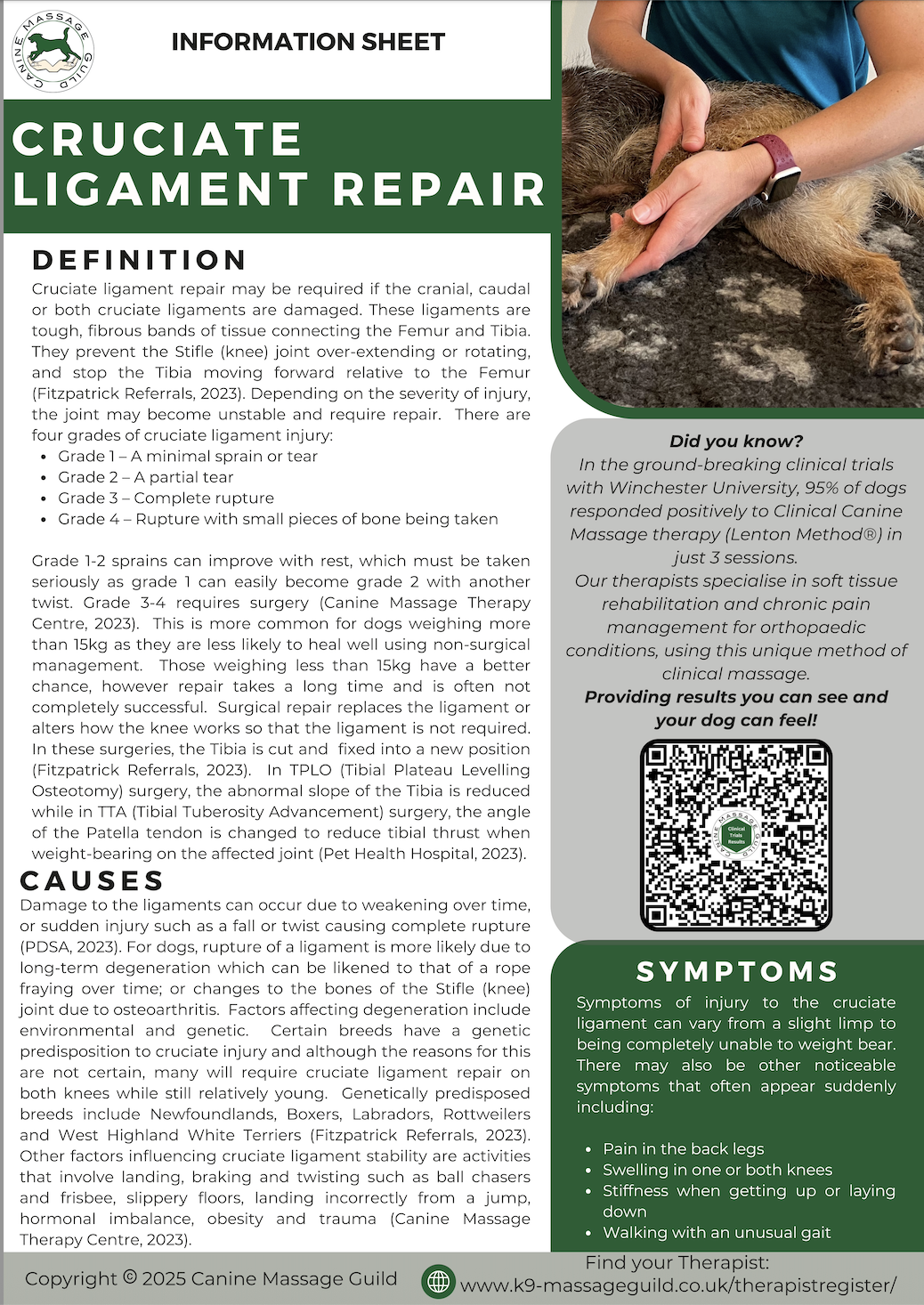
Download your free pdf copy here:

Did you know the 5 PRINCIPLES OF PAIN
can help you identify potential signs of Cruciate Ligament Repair?
Here are some of the issues that you might be noticing
Download your free copy pdf now.
GAIT
- Lameness – limping or hopping
- Reduced range of movement in the affected leg
- Abduction or adduction of the leg
POSTURE
- Reduced weight bearing on injured limb
- Sitting with one leg held out to the side
ACTIVITIES OF
DAILY LIVING
- Struggling to get up or lie down
- Slipping
- Reluctance to go on walks or play
BEHAVIOUR
- Snapping at other dogs
- Excessive licking
- Reluctance to be petted or groomed
- Disinterested in activities
- Appearing depressed, anxious and isolating themself
PERFORMANCE
- Impaired performance in sporting activities
- Slowing down on walks
How may Clinical Canine Massage help my dog with Cruciate Ligament Repair?
BENEFITS
Clinical Canine Massage helps with a variety of issues while the cruciate ligament is healing regardless of the grade or the method used to repair the ligament.
In the grade 1-2 sprain of the ligament, massage will help with pain, swelling and improving mobility especially as the lameness and change in gait will have an impact on other muscles of the body.
Following surgery for a grade 3-4 rupture, massage helps with reducing inflammation, pain and healing, as it can help to rid the body of toxins and improves the level of comfort.
Alfie had surgery for cruciate ligament disease in 2020. Alfie has been having regular massage for some time now and his guardian has reported that he is happier and runs around with the other dogs. His guardian feels that massage is clearly beneficial as she can see the difference when it has been a while between treatments.
Did you know?
In the ground-breaking clinical trials with Winchester University, 95% of dogs responded positively to Clinical Canine massage therapy (Lenton Method®) in just 3 sessions.
Our therapists specialise in soft tissue rehabilitation and chronic pain management for orthopaedic conditions, using this unique method of clinical massage.
…and the results are in!
Click the button to the research results published in Vet Report
Providing results you can see and your dog can feel!
Clinical Canine Massage - discover the difference it can make to your dog!
Find a therapist
Have a look at our Register to find the Canine Massage Guild therapists in your area.
What to expect
Find out why your dog might need a massage and what to expect in our Owner Zone.
What people say
Read some of the many testimonials from satisfied Canine Massage Guild clients.