Arthritis, Fascia and Pain
What is fascia?
Fascia is the cling film like substance that wraps every muscle fibre, organ, bone, nerve and blood vessel – it’s everywhere. Sometimes referred to as connective tissue, this dynamic system is made up of elastin and collagen fibres. It is lubricated by ground substance and has an abundance of free nerve endings. It is essentially a giant ‘net’ that supports and integrates the entire body. It moves, it ‘feels’, it responds to touch, it senses pain and importantly it is the environment in which the nervous system lives.
As dog owners, we need to know about fascia because it affects every aspect of our dog’s lives from movement and mobility through to mood and behaviour.
Why is fascia important when it comes to understanding our dogs?
As owners, we know different variables affect our dog’s health and longevity such as; diet, weight, age, stress, environmental factors, ageing and so on. But did you know that when fascia becomes dysfunctional through injury, stress, disease, mobility issues, ageing and arthritis it affects not just the mobility and ability of our dogs but also their emotional state?
“Fascia is the system that touches all others, it not only links the muscle, bones and nerves, but also our mood, emotions and behaviour. This is true of both dogs and humans”. Pischinger (2007)
So to recap

Shutterstock
Dysfunctional fascia or connective tissue can cause or contribute to:
- Mobility problems
- Pain
- Behavioural Issues
- Mood e.g.: depression/anxiety
- Can be commonly seen in the 5 Principles of Pain
Arthritis, Fascia and Pain
To manage the chronic pain caused by arthritis and other orthopaedic conditions the fascia and muscles of the body always need to be addressed.
Why? Because it’s the muscles and fascia which pull on the bones to produce movement. With its visco-elastic properties fascia is responsible for shock absorption and elastic recoil which helps to free up momentum in movement. Think cushioning and support which is needed more than ever when arthritis is present. The functionality of fascia will influence the mobility of the dog during locomotion as well as the comfort of their soft tissues in a resting state.
Primary arthritis occurs due to ageing through the erosion of the hyaline cartilage which covers the ends of joints. Secondary arthritis occurs due to incongruity of joints, e.g. hip and elbow dysplasia or as a consequence of other conditions such as diabetes. Whichever type of arthritis your dog has, the fact remains that it’s the soft tissues of the body which contribute to the support, movement, protection and functional capability of the joint.
Why does arthritis affect fascia and vice versa?
Bones and joints cannot move themselves. The body is a system of levers and pulleys. The muscles and fascia have to pull on the bones to produce movement and surround the bone to give it support. When arthritis is present the joint is weak and requires surrounding soft tissues to respond by recruiting extra support from each other and surrounding areas causing the muscles and fascia to take on an abnormal load.
This is where the concept of overcompensation comes from. It can happen both locally in surrounding areas and in seemingly unrelated parts of the body far away from the site of concern. This is why a dog with arthritis of the hips would show overcompensation commonly in the neck and shoulders as the weight is thrown forward to relieve the hind quarters. With fascia it can be useful to think of one large 3D net that surrounds and interpenetrates the whole body. Pull on the bottom of your t-shirt, see how it moves your collar too? This basic principle when applied to the body can help us to understand why it is not just tissue in the local area that is affected.
Any body part that works harder is going to tire and wear out quicker, and this is what we see with fascia and muscle as they attempt to ‘rescue’ the joint. Muscle will become hypertonic, this means it will constantly be ‘switched on’ and unable to return to its normal resting tone. This results in persistent aches, pains and stiffness. Fascia will accrue painful trigger points which will eventually lead to further weakening of the joint as well as affecting proprioception, pain and mobility levels. So, you can see that not all pain associated with arthritis is down to inflammation in the bone.
So to recap:
- Arthritis causes a mechanical weakness in the joint.
- Muscle and fascia has to work harder as it attempts to take excessive load off the arthritic joint.
- These soft tissues then start to accumulate problems and weakness leading to further weakening of the joint.
- The dog will overcompensate with other areas of the body leading to more painful areas.
- Not all arthritic pain is due to bone, it is also the surrounding muscle and fascia as well distant sites of overcompensation.
The pain cycle of fascia and arthritis.
A vicious cycle now begins as the muscles and fascia are worked beyond their capacity. They tire easier and their own instability means they injure with debilitating strains (tears to the muscle). They accrue painful myofascial trigger points and restrictive adhesions along with other issues which further exacerbate the weakness in the affected and neighbouring joints.
As the muscle and fascia are now weaker through overwork, the joint becomes more and more fragile. The unreliability of surrounding soft tissues then sees the dog start to shift their weight to a different area or use another leg more to take pressure off the affected joint. Distant parts of the fascia then overcompensate becoming heavily, and inappropriately, used thus storing habitual patterns of tension in the body.
This cycle continues leading to ongoing chronic pain.
 Breaking the Pain Cycle with Clinical Canine Massage.
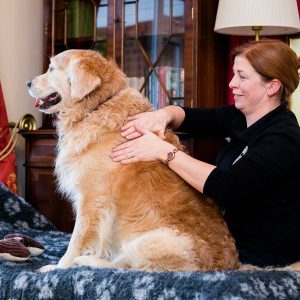
If your dog is living with arthritis or another orthopaedic condition and you’re looking for ways to improve their mobility and manage their pain levels, the good news is that clinical canine massage is a viable and accessible treatment option. With a proven track record, a therapist register of over 120 practitioners in the UK, Ireland, Spain, Italy and Asia. It’s been so successful that it’s currently in clinical trials with 2 well respected universities in the UK.
Now we’ve learnt how intrinsically connected the fascia, muscle and bones really are it seems obvious that for true management to occur the soft tissues must be addressed too.
In order to successfully break the pain cycle involved with arthritis; muscle and fascia must be addressed. If you only address the joints with NSAIDS and supplements it’s like checking the tyres and chasis of your broken car without looking to see if the engine is working.
The fascia and muscles ARE the engine of movement. When they aren’t working, movement isn’t going to happen as effectively as possible. Overuse of fascia causes it to become stiffer, less flexible and restrictive.
Clinical canine massage aims to provide you with a solution:
Problem 1: Dysfunctional fascia causes mechanical restrictions on the joint. To use our earlier analogy, a tight ‘pulley’ (muscle or fascia) will restrict range of motion of the levers (bone and joints).
Solution: The clinical canine massage therapist uses a set of advanced massage techniques called ‘Myofascial Release’ to specifically address these restrictions. Fascia is moved and slackened to bring, space and length and in turn freer movement to help range of movement (ROM) in the arthritic joint and relieve stiffness.
Problem 2: Fascia has thousands of free nerve endings. When the fascia is restricted it will ‘strangle’ these nerve endings causing unnecessary pain. Fascia houses nociceptors (pain-detecting nerve cells), mechanoreceptors (neurons that detect pressure and stretch) and proprioceptors (detecting motion and body position). When fascia becomes dysfunctional, nociceptors become overstimulated which is a common contributing factor of chronic or ongoing pain. Mechanoreceptors and proprioceptors will be unable to respond normally or effectively and will affect the dog during locomotion as well as their ability to read normal sensation from both the external and internal environment of the body.
Solution: As the fascia is rehabilitated with specific myofascial release techniques, the nerves are essentially freed up. Over-sensitisation of the nerves is reduced and therefore chronic pain can be managed and in some areas resolved.
Common outcomes of clinical canine massage with the arthritic dog.
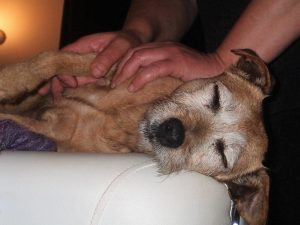
- Easier getting up and down
- Able/more interested to go on walks
- Increased range of movement
- Reduced stiffness
- Improved appetite
- Improved mood
- Wanting to play
- Finding it easier to get on/off sofa
- Easier to get in/out of car
- Improvements in gait and posture
- A happier dog
Summary.
- Fascia is everywhere, it’s a 3D matrix that unites the entire body
- Arthritic joints are weak and need more stability which can only be provided by fascia and muscle
- Muscle and fascia surrounding the arthritic joint become tired, spasmodic and dysfunctional when overused persistently
- Without the support of the muscle, further weakness in the joint occurs
- The dog will over-compensate in other areas of the body or with a different leg causing more pain in local and distant areas
- When fascia is released it improves range of movement of the joint and decreases chronic pain
- Clinical canine massage is a viable therapy for re-educating fascia, reducing irritation on nerves and improving quality of life and mobility
- Common outcomes of canine massage therapy are the improvement of activities of daily living, quality of life, gait, posture and behaviour.
The takeaway:
If pain management for arthritis is to be successful, fascia and muscles must be treated. If they aren’t, only half the issue is being addressed and your dog’s treatment is incomplete.
To help your dog or a dog you know with arthritis visit the Register of Clinical Canine Massage Therapists today at
References:
Travell and Simons’ Myofascial Pain and Dysfunction, Lippincott Williams & Wilkins, 1998
Pischinger, Extracellular Matrix and Ground Regulation North Atlantic Books, 2007
D. Lesondak, Fascia: What it is and Why it Matters, Handspring Publishing, 2017
R. Schleip Fascia: The Tensional Network of the Human Body: The science and clinical applications in manual and movement therapy Paperback, 2012
G. Arthurs, D. Brown, R Petit, BSAVA Manual of Canine and Feline Musculoskeletal Disorders (BSAVA British Small Animal Veterinary Association) Paperback – British Small Animal Veterinary Association, 2018
About Natalie Lenton
Natalie Lenton is Director of the Canine Massage Therapy Centre and creator of the Lenton Method™, a 3-tiered approach to canine bodywork that trains therapists in palpation, fascial and muscular injury identification and myofascial release protocols to bring space, movement and comfort to the joints of the canine body. This method is taught by Natalie and her team of instructors on the LANTRA-accredited, 2-year Clinical Canine Massage Practitioner Programme. She is also the founder of the Canine Massage Guild.
Trained therapists benefit from continuing professional development with advanced bodywork courses in neuromuscular facilitation, manual lymphatic drainage, deep tissue and facilitated stretching. Courses are written and delivered by Natalie, who has also established a Workshop Instructor Programme to help experienced therapists who want to teach canine massage themselves.
Not only does she train therapists, but Natalie also delivers a variety of 1 day self-interest workshops for owners, and has authored the best-selling DVD ‘Canine Massage in 3 Easy Steps’ through which thousands of owners across the world have learned how to help support their best-friend’s health at home.
With a background in journalism Natalie is also a featured writer in the canine press and lives with her 3 best friends, a JRT, rescue greyhound, collie x terrier and her partner in Worcestershire, UK.