Natalie Lenton guides you through some of the interesting basics, some fascinating facts and some little known information on your dog, gait, conformation and anatomy…
A – Angulation: The angle formed by bones which meet at various joints. Examples of this include the Shoulder, the Stifle and the Hock as well as the Hip. The spinal column and assembly of the pelvis and croup will also determine how the dogs overall construction as well as tail set appears. Importantly the angulation of a dog will impact on their strength, ability and function. Angulation will differ from breed to breed with dogs such as the Belgian Shepherd having less angulation of the Shoulder and therefore appearing more ‘upright’ than for instance the Labrador. A dog who’s natural conformation has a severe lack of angulation in a joint such as the Stifle will be more predisposed to Degenerative Joint Disease and for instance in the stifle Cruciate Ligament Disease.
B – Beat: This is the term used to describe different patterns of Gait and their rhythm of the footfall. The Trot, Canter, Gallop and Double Suspension Gallop are all characterised by the pace and rhythm at which the dog moves. Think of the beat as a time signature for a certain gait (see D, G, P, T for examples)
C – Conformation: Refers to the externally visible appearance as determined by the muscles and skeletal assembly of the dog. This should also take into account the Angulation of the dogs joints, their skeleton e.g.: skull, ribcage, tail set and topline. Conformation is not just about one part of the dog, it is rather about looking at the dog as a whole. A poor conformation may include the incorrect hip angulation of a dog that in turn will impact on the reach of the forelegs, for example a dog that has been bred out of or has exaggerated joint angles. It can also refer to weak areas such as the hock (again determined by standard), muscular atrophy and abnormal posture.
Conformation will also determine the Kinetic Balance of the dog; that is the dog in motion. What job was the dog originally bred to do? What was their purpose? For example the Greyhound has a relatively long, upright hock and when we look at its adversary (i.e.: the Rabbit or Hare!) we can see that so has the prey. The angulation and length of the hock (which has within it 7 bones) perfectly matches their opponent with both animals needing a fast getaway and the ability to make fast turns. The exaggeration of angulation or conformation features will be detrimental to the dog’s ability to be ‘Fit For Function’. A respect for conformation is what sets apart a responsible and dedicated breeder to a common or garden ‘dog fancier’.
In Anatomy a common statement is ‘Form Follows Function’.
D – Double Suspension Gallop: A four eat gait this is the only gait where the dog has full extension. The spine needs to be able to flex and fully extend with the back legs having to come right underneath the body to achieve this. The front legs will be in full extension forwards and the rear legs are able to fully extend backwards. When the feet pass each other, the front feet are inside of the rear feet.
E – Endurance: In anatomy a common statement is ‘Form Follows Function’. In the case of dogs over years certain traits have been selected for certain activities or jobs. The hunting and herding dogs have been bred over hundreds of years selectively to enable them to work for long hours over all types of terrain. The most selected gait for endurance is the Trot (see T) and any action which wastes energy is a way of determining lack of efficiency which in turn raises concerns regarding conformation. Joints should not be over angled, nor should they be too upright. The endurance of a dog is testament to its working ability although don’t confuse endurance with fatigue. Muscle fatigue is often seen in the sporting gun dog. A long day out in the field in perhaps cold and damp conditions will make muscle use up its stores of glycogen quicker, a dog that has used up its energy is most likely to go into cramp or uncontrollable shaking. So going back to endurance, the question is, could the dog in front of you do an honest days work? (if that is their purpose).
Don’t confuse poor Endurance with Fatigue
F –Fascia: This wraps every fibre and muscle, it envelopes every organ and bone and can be thought of as the cobweb over the dogs body. It is a living matrix made up of collagen, water and proteins and is incredibly powerful. It holds posture, body contours and allows everything in the body to slide and glide. When it becomes stuck or adhered together, painful Trigger Points can occur which strangle or trap nerves, reduce blood flow and cause a pattern of referred pain in parts of the body. Underneath the dogs skin is a sheath of fascia that should move freely from the skin if it’s adhered it may cause skin Quivers (see Q for further reasoning). Fascia will cause Myofascial pain which can make a dog seem old before its time, fatigue quicker and when it becomes tight it can also change the posture and gait of the dog.
G – Gallop: A 4 beat rhythm will all 4 feet off the ground. The speed you will see in action down at the Agility Rings at Crufts. To excel at the gallop the hind legs and forelegs need to be able to reach their full Muscular Potential (see M) with the extension of the shoulders and forelegs reaching as far forward as possible and the rear legs being able to shift underneath the dog to propel them forward. The 0-60mph muscle on a dog is called the Gracilis and it is this muscle which propels them forward (along with the reach of the forelegs of course)When a dog goes from a stand still to a gallop in the blink of an eye it is the Gracilis (which can be located on the inner side of the thigh and inserting onto the inner aspect of the Tibia; shin bone) which allows the dog the power to do this however the front of the dog must also have the reach to achieve this motion and any issue within a shoulder muscle (in particular the Teres Major) will impede efficient motion, restrict shoulder extension and cause fatigue.
H – Hackneying: The legs step high in an exaggerated motion with no padding of the paws, the forefoot is raised to high to work efficiently. Named after the hackneying action of carriage horses this type of gait is characteristic of breeds like the Miniature Pinscher but frowned upon in others. Obedience dogs are taught to Hackney for aesthetic purposes and a handler can cause a dog to Hackney by ‘stringing’ a dog up. This is a reason that many serious show judges will prefer to see a dog on a looser lead so we can see their true gait. However too loose and you may see Winging (see W).
The Greyhound has a relatively long, upright hock and when we look at its adversary (i.e.: the Rabbit or Hare!) we can see that so has the prey
I – Interfering: When the moving foot strikes the support foot. Often directly related to the conformation of the dog and in some cases, unfortunately, its natural assembly. Dogs with narrow chest or with toes that angle outwards tend to have a gait defect that will cause the leg to swing out and so one leg hits the other. In some cases it can because of a muscular problem where a muscle simply needs to be lengthened with good bodywork. In the Greyhound this is sometimes called ‘Track Leg’ and can be the cause of injuries, lacerations and swelling. Please note: this is different to single tracking.
J – Joints: This is where one bone articulates with another. Joints are classified as Structural which is how they connect to each other while Functional classification determines the degree of movement. The ends of bone are covered in something called Hyaline Cartilage, when this wears, tears and degrades over time this is the start of Osteoarthritis. Supplements such as Glucosamine, Chondrotin and MSM can help to give the body the material it needs to aid in repair. Joints are held together and stabilised by Ligaments which are made primarily of Collagen. A tear to a Ligament is called a Sprain of which there are 4 Grades. Poorly angled joints and those that have been injured have a higher likelihood of developing Arthritis so it’s important to limit activities which place a high degree of pressure on joints, for example ball launching and jumping in and out of cars with high boots like 4 wheel drives which will put pressure on the lower back, hips and stifle when jumping in and on the wrists, elbows, shoulder and neck on the way out.
Joints are classified as Structural or Functional
K – Knitting & Purling: A gait fault where the elbows twist out, the forelegs cross at the wrist and end with toeing out. This can happen both in front and behind although is most commonly seen on the forelegs. As the dog has a lesser degree of rotation from the shoulder this action will place a lot of stress on all the joints of the foreleg and may be caused by Injury, Panosteitis and poor natural angulation of joints.
L – Lameness: This is a disturbance in movement or gait caused by pain and injury. There are 5 types of lameness: Regional Lameness: Lameness in a particular part of the leg e.g.: Stifle -Cruciate Ligaments, Complementary Lameness – Weight is redistributed from one painful leg to another, typically this occurs asymmetrically although some dogs will refer laterally (same side) depending on the injury. This means that lameness seen in one leg may actually be secondary overcompensation so therefore the leg you are seeing the lameness on is not necessarily the leg of primary concern. Swinging Leg Lameness – commonly referred to as `throwing a leg` this abnormal movement may also result in failure to flex a joint when the leg is in motion. Common causes include muscle strains. Weight Bearing Lameness – lameness is caused by the dog not putting weight on the leg rather than by movement. This is commonly indicative of issues such as Cruciate Ligament or OCD Three Legged Lameness – the dog may hold a leg off the ground on the stand or on the move. Lameness can be caused by Muscular Injury, Orthopaedic Disease or Issue e.g.: Arthritis, Luxating Patella and also Neurological Issue e.g.: Intervertebral Disc Disease, CDRM
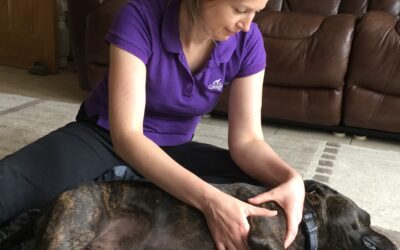
M –Muscle: Accounting for a massive 45% of bodyweight and up to 55% in the Greyhound, muscle is made up of millions of protein fibres (Actin & Myosin). Your dog has around 700 muscles that pull onto the 320 bones (length of tail depending) to produce movement. Every muscle will cross at least one joint and they all have an individual action. They will joints to be flexed, extended and rotated and as muscle is the prime mover it is therefore the first point of call for injury and lameness. An injury to a muscle is called a Strain. This is where the muscle goes beyond its natural range and tears. At some point all dogs will Stain or Pull a muscle due to normal day to day activity and play. However an injured muscle is never a sound muscle and the best type of bodywork for your dog to help resolve or support muscular injury is massage which is the scientific application of measured techniques upon specific muscles from their Origin (where they begin) to their Insertion (where they end) a sound knowledge of anatomy is a must.
Muscle accounts for a massive 45% of the dogs bodyweight.
N – Neckline: The dog has 7 Vertebrae in the Neck called the Cervical Vertebrae. It supports the movement of the head. The first vertebrae is called the Atlas and is sometimes called the ‘Yes’ joint as it provides this motion. The second vertebrae is called the Axis responsible for the ‘No’ motion. Dogs with longer necks will usually have a better lay of shoulder blade and it’s important to remember that some of the muscles which originate in the neck are actually responsible for moving the foreleg. This is why sometimes a dog that has foreleg lameness doesn’t have a problem in the leg, they have a problem in the neck.
O – Over Reaching: This can be caused by a dog that is short in the lumbar area (loin) and has more drive from the rear than can be compensated by the forelegs. To avoid interference the dog can be forced to move one leg aside so they don’t clip the leg. If the dog is over angulated on the front the dog can be forced to land heavily on the foreleg which over time will place undue stress on the ligaments and tendons of the wrist.
P – Pacing: Rather than a 2 beat diagonal gait this is a 2 beat lateral (same side) gait. On the trot the dog should naturally use asymmetrical legs. Some dogs will develop a pace to avoid interference perhaps due to injury or tight musculature; when relating to the skeleton pacing can occur due to over angulation of the hip and/or shoulder, it can also occur due to an injured tail. The pace can be a natural way of a dog conserving energy but on the trot they should naturally use diagonal legs.
If you see your dogs skin ‘Quiver’ it can be a sign of Myofascial Pain
Q –Quivers: If the skin of the dog ‘Quivers’ or ‘Skin Crawls’ this is a strong indicator of Myofascial Pain. To test you dog place a flat hand near the last rib and sweep up against the fur. If you dog quivers it may due to over tightened plains of Fascia (see F) when Fascia becomes tight it can reduce circulation, strangle nerves, deprive the muscle of blood and nutrients and cause pain referral e.g.: in the human they may complain of muscular pain in the arm where actually the source of it comes from the back of the neck. Myofascial Pain is dependent on having the muscles worked upon with a modality such as Canine Massage, Mctimoney Animal Manipulation or Bowen Therapy. A dog that drinks very little will be more prone to Myofascial Pain as the Fascia is made up of chains of collagen and water, dehydrated fascia will lead to Myofascial Pain which feels like a dull persistent ache over a large area. You may see your dog restless or unwilling to be groomed in certain areas e.g.: the neck, back of rear legs (Hamstrings) Other causes are muscular injury (the Strain), repetitive activity, overcompensation and even long periods of rest or prolonged set in one position e.g.: sleeping in curved plastic beds.
Roaching and Swayback are both used to describe deviations of the dogs topline
R – Roaching: An arched back is called ‘Roaching’ and will denote that the dog has back pain. They may be reluctant to be touched on the back, the skin may quiver or you may see your dog doing a lot of rolling around on their back like they are trying to ‘rub’ their back. The cause of Roaching is usually injury to the muscles that stabilise the spine; it can be due to subluxated (or twisted) vertebrae. However if your dog does this only really after mealtimes it is advisable to see your vet for underlying causes which may be digestive or kidney based.
S – Swayback: Rather than arching upwards (See Roaching) the middle of the back dips downwards and goes concave. It can look at though the back is sagging. This is commonly seen for instance in older Labradors but every breed can of course be affected. Swayback can occur due to muscular injury, a build of tension in the muscles that cause them to harden and deform the lay of the spine (this is called Hypertrophy) or in the older dog can be due to issues such as Spondylosis. Tight, sore, aching muscles will cause a change in the posture of your dog, yet another reason why Bodywork is so very viable as part of a dogs healthcare regime.
You have 7 vertebrae in your neck and so does your dog
T – Trot: A 2 beat gait which uses asymmetrical or diagonal limbs. Two feet are on the ground at all times as the back left and front right move together with a smooth transition to then the opposing legs. The trot should be smooth and effortless; it should look natural and not laboured. Equilibrium of the dog is maintained through this diagonal gait. A tight lead can interfere with the trot and make it look although there is a gait irregularity there when in fact it is due to poor handling. A dog who is in discomfort or pain may attempt to ease itself by Pacing or Crabbing.
U – Under Performing: Whether in the show, obedience of agility ring when a dog has lost their zest for whatever discipline they compete in, under performing should always be as objectively analysed as possible. Has the dog had an injury e.g.: doing a somersault while chasing a ball, being shoulder barged by another dog. Has the wear and tear of day to day inappropriate repetitive activity taken its toll and accrued stress to the skeleton and its muscles? e.g.: Jumping in and out of a 4 wheel drive care or slipping on laminated floor. Has their food been changed? Has there been bereavement in the pack/family. There is always a reason for a dog under performing whether that is physical or psychological. You know your dog better than anyone so always stand back and take a look at what’s happening in their life.
V – Vertebrae: The spinal column of the dog is made up of the following formula. In the neck the dog has 7 Cervical Vertebrae (as do you); along the topline the dog has 13 Thoracic Vertebrae (you have 12). At the end of the rib cage start the Lumbar Vertebrae of which there are 7 Lumbar Vertebrae (you have 5), on top of the Pelvis lie 3 Sacral Vertebrae (you have 5) and the Coccygeal or Caudal vertebrae of the tail will have up to 21 depending on the length of the tail (you will have 4 bones in your coccyx although it is known that some people have 3 and others 5). The vertebrae provide vital housing and protection for the spinal cord as well as it being a flexible rod of the body. Back care is so very important to the dog as the dog’s spine has much more flexibility than our own (but your own back care is very important to!) Tight, inflexible injured muscles, sub luxated vertebrae, compressed discs, degenerative disc disease, Spondylosis, Cauda Equina disease….the list goes on. How often do you get your dogs back checked?
W – Withers: The highest part of the shoulders. Anatomically we refer to this as the Dorsal Aspect of the Scapula and in between these Scapula’ is where the Cervical or neck vertebrae end and the Thoracic or upper portion of the back begins. Ideally the neck and the shoulder should slope gently together, any sudden abrupt change of angle can denote that there is a lack of Angulation (see A) of the shoulder joint. To know truly where the dorsal scapula lays you should be able to feel two bony prominences just behind the base of the neck. These are the top of the scapula.
X – Xiphoid: At the end of the sternum is a disc made up of cartilage called the Xiphoid Process. Go on, have a feel and see if you can locate your dogs! This is easiest done while the dog is lying on their side although in some breeds with a deep ribcage like the Pointer or Greyhound you can feel it stood up. Follow the sternum down and when you reach the first fleshy part of the abdomen you may be able to feel a disc which will range in size depending on the dog from a 5 pence piece to a 10 pence piece. The purpose of the Xiphoid Process is to provide an anchor point for muscles including the Rectus Abdominus (equal to the 6 pack on the human) and also the Diaphragm which is a sheet of internal muscle that separates the thoracic cavity from the abdominal cavity and is used in respiration; as it contract it aids in drawing air into the lungs
Y – Yellow Gums: can indicate that dogs circulation is in danger, get them to the vets ASAP. Your dog’s gums should be pink and healthy. Take a look now. You should be able to press gently on the gum and note how it goes white and then pretty instantaneously it goes back to being pink. This is called a Capillary Refill Test and is a quick and easy way to measure the flow of blood returning back to the capillaries and its peripheral perfusion (that is the delivery of blood to capillaries which carries with it oxygen and nutrients) If you ever look inside your dogs mouth and it looks yellow, and like rotting meat, if you do the capillary refill test and blood does not flow back within a couple of seconds this is the cue to get your dog to the vets as an emergency. You may see outward signs such as fatigue and laboured breathing. Don’t delay, no matter what day, no matter what time, get your dog to the vets; it could just save their life.
Z – Zygomatic Arch: There are 3 shapes of dog skull; The Brachycephalic flat faced breed like the Bulldog and Pug; The Dolichocephalic with a long narrow head like Greyhound and Borzoi and the Mesaticephalic which is intermediate like the German Shepherd and Collie. No matter what type they all have something called a Zygomatic Arch and it is this which determines the width of the head. It is prominent in Brachiocephalic breeds and is flat on Doliocephalic breeds. It extends from the opening of the ear canal and progresses in an outward and forward direction to form a bony arch found underneath the eye.
Natalie Lenton is Director of the Canine Massage Therapy Centre and can be found in Hall 1, Stand 24 and Stand 24a with the Canine Massage Guild performing FREE muscular health checks for dogs this year at Crufts. She is also Tutor on the 2 Year Therapeutic Canine Massage Diploma, runs a busy clinic, 1 day workshops for owners and a Canine Natural Healthcare Shop which can be found online at www.K9-Massage.co.uk