Old Dog Syndrome is a commonly used description for a real condition called Canine Idiopathic Vestibular Syndrome, a disorder which affects the Vestibular System in dogs.
The term “idiopathic” in the name means that the actual cause is unknown, and as a result, there is no cure for this condition. Instead, the symptoms are managed to support the dog through what can be a distressing experience for them.
Canine Massage is potentially one of the best possible ways to help a dog recover from Old Dog Syndrome – you can read more about how massage helps later in this article in the section: How can massage help?
In this article:
What is the Vestibular System?
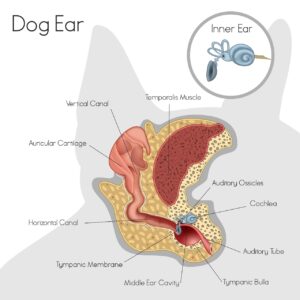
The Vestibular System is part of the Central Nervous System and is responsible for maintaining a dog’s balance, posture and orientation in relation to the horizon and gravity. The Vestibular System also regulates locomotion, other movements, such as preventing the dog from falling over, and keeps objects in visual focus as the body moves. It does this by detecting the position and movement of the head, and coordinating this with the relative position of the eyes, trunk and limbs.
The Vestibular System is based inside the dog’s ear and consists of three main parts:
-
- Vestibular Apparatus – five receptor organs located in the inner ear that are sensitive to movements and the influence of gravity on the dog’s head.
- Vestibular/Vestibulocochlear Nerve – this collects information from the Vestibular Apparatus and the Cochlea, and transmits it to the Brain stem.
- Lower Brain Stem – this interprets information received via the Vestibular Nerve along with proprioceptive information from muscles and joints to determine the dog’s current spatial orientation.
What are the symptoms of Vestibular Disease?
Vestibular Disease is a condition where the dog exhibits a sudden loss of balance and coordination due to a malfunction of the Vestibular System.
The symptoms are similar to those commonly associated with strokes in people, although the dog’s experience is more like that of vertigo in humans, with signs including:
-
- head tilt to one side – this is typically the last symptom to resolve, and sometimes remains permanent
- circling – the dog wants to move or circle in one direction
- nystagmus – rapid, involuntary eye movements while the dog is awake. It looks like the dog’s eyes are twitching back and forth.
- ataxia (lack of muscle coordination) – the dog can be unsteady, off balance, and have trouble standing or walking normally
- leaning or falling to one side – the whole body might tilt one way, or keep falling to the same side
- difficulty standing – the dog may spread their legs wide in an attempt to stay balanced, or may be completely unable to stand unassisted
- drooling or licking – signs of nausea, essentially the dog has motion sickness due to dizziness
- vomiting – again, due to motion sickness
- reluctance to eat or drink – caused by nausea and/or loss of coordination, making these activities physically difficult for the dog
- restlessness and panting – signs of anxiety and discomfort, because the dog is distressed and not sure what has happened

What causes it?
There is no known breed predisposition to Vestibular Disease. Common causes include:
-
- ear infection (otitis interna)
- trauma – e.g., overcleaning of the ears, causing a perforated eardrum
- hypothyroidism – often seen in older dogs with a history of ongoing vestibular issues
- stress
After ear infections, Idiopathic Vestibular Disease, aka Old Dog Syndrome, is reported to be the most common cause of Peripheral Vestibular Disease in dogs. The actual cause is unknown, although some sources believe it happens due to a problem with fluid flow in the ear. The average age of dogs that develop Idiopathic Vestibular Disease is 12 to 13 years, but it can be experienced by dogs of any age.
How can it be treated?
Where the underlying cause is known, for example Hypothyroidism or an ear infection, these can be treated accordingly. However, this isn’t as straightforward when the condition is idiopathic.
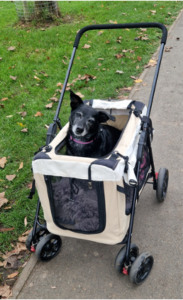
Image credit S Clark 2024, used with permission
Dogs experiencing Old Dog Syndrome can be treated with medication for their initial acute symptoms, in particular for the nausea and vertigo, so that they can resume normal eating and drinking patterns as soon as possible.
Further to this, supportive care and physical rehabilitation are essential to assist the dog in the recovery of their movement and balance.
The dog’s home environment during recuperation should be made safe from potential injuries, so it is crucial to block access to hazards like stairs, furniture, and open water sources such as garden ponds. Runners should be put down on slippery flooring to help the dog to navigate their way around.
A calm, quiet environment that minimises stress is important, with well lit areas to avoid the dog becoming disorientated in darker spaces.
A harness may be needed to assist with mobility, and a dog buggy can be used to take the dog to a nearby park or open space if they are unable to walk very far, bearing in mind that the dog may continue to experience motion sickness when being moved.
How can massage help?
As mentioned at the beginning of this article, Massage Therapy is one of the best possible ways to help a dog recover from Old Dog Syndrome. In clinical trials conducted with Winchester University assessing the efficacy of the Lenton Method ® of Canine Massage, 95% of dogs responded positively to Clinical Canine Massage Therapy. The results are published in ‘Vet Record’ by the British Veterinary Association.
Inactivity and recumbency result in muscle weakness and the shortening of muscles and tightening of soft tissues, which causes joints to stiffen, limiting their movement. After the initial severe symptoms have subsided and the dog is ambulating (moving around more), they will likely be compensating for balance issues by favouring certain muscles or shifting their weight, which alters their gait. Muscles have to work harder to protectively splint areas that are overcompensating for the impediment of balance and stability.
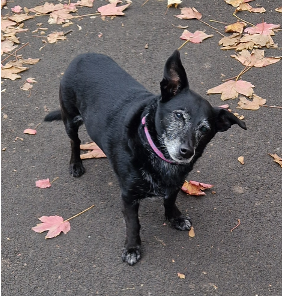
Image credit S Clark 2024, used with permission
The dog’s head tilt – which can be steep and persist for some time, or indefinitely in some cases – will cause a number of issues in the cervical and thoracic areas, including hypertonicity; excess stress in the muscles, trigger points and myofascial pain, all of which restrict movement. Problems in the dog’s neck and shoulders can also manifest as issues in their lumbar and pelvic regions.
Canine Massage can assist rehabilitation from Old Dog Syndrome in multiple ways:
- Improves Circulation
-
- Massage helps stimulate blood flow, which brings oxygenated blood and nutrients to the tissues. This aids tissue repair, reduces muscle stiffness, and helps to improve muscle function.
- Lymph flow is also enhanced by massage, which reduces toxins and metabolic waste products in the body and boosts the dog’s immune system with more antibodies.
- Good circulation is particularly important for areas of the dog’s body which have been impacted by Vestibular Disease, where circulatory fluids can be impeded or stagnated in an area that has become immobile.
-
- Relieves Anxiety and Stress
-
- Dogs with Vestibular Disease are likely to feel anxious and disoriented due to their loss of balance. Gentle, soothing massage techniques will stimulate the Parasympathetic Nervous System, which can help the dog to be calmer and reduce their anxiety and stress levels. This also helps the dog to feel grounded and secure when their world has literally been turned on its side.
-
- Aids Proprioception and Body Awareness
-
- Massage improves and releases muscular and fascial constrictions, leading to reduced irritation to sensory nerve endings in the fascia, and aiding the efficiency of nerve impulses informing the brain where the body is in a space.
- This is a vital part in the rehabilitation of Vestibular Disease, giving the dog the foundation for regaining their balance and motor (movement) control through improved neural feedback.
-
- Enhances Mobility
-
- Massage therapy is helpful for restoring muscle function after periods of immobility and improving a dog’s ability to move around, even if they are struggling with coordination.
- Massage relaxes and lengthens muscles which improves muscle tone; reduces the likelihood of strains and helps to decrease atrophy and hypotonicity caused by lack of balance and overcompensation.
- Massage gently stretches connective tissues which eases tightness and enables muscles to move more freely and work naturally, increasing the dog’s range of movement in their joints.
- Restrictive trigger points (“knots”) in the muscles are reduced through massage which strengthens muscles and restores their natural function. This is important when a dog has been using their muscles in an irregular manner, and it will aid their recovery or improvement of normal movement.
- Massage therapy is helpful for restoring muscle function after periods of immobility and improving a dog’s ability to move around, even if they are struggling with coordination.
-
- Areas of Overcompensation
-
- Dogs with Old Dog Syndrome will be uncoordinated and struggle to balance properly until they have recovered. By continually leaning to one side and using muscles in an abnormal way to achieve any form of movement, the dog will create areas of overcompensation in their body resulting in muscle tension and creating more issues in different parts of their body.
- Massage strengthens the muscles, relieves hypertonicity and helps to rebuild atrophied muscle. This addresses areas of overcompensation and protective muscle splinting, which will enable more equal weight bearing and the dog’s use of their limbs.
-
- Pain Relief
-
- From a veterinary perspective a dog with Vestibular Disease will not be in pain, however all of the resulting peripheral and secondary issues will nevertheless cause discomfort or pain for the dog.
- Massage is an excellent therapy for providing natural pain management and bringing comfort and relief from soreness. This is achieved by addressing trigger points and myofascial pain in the muscles; reducing areas of stiffness, referred pain and overcompensation; improving circulation to enhance tissue repair and flush out waste materials, and encouraging a sense of grounding and calm through stimulation of the Parasympathetic Nervous System.
-
Conclusion
The signs of Old Dog Syndrome can be very distressing for the owner and debilitating for the dog, since their whole world has been turned upside down overnight. However, the natural benefits of massage are invaluable in enhancing recovery and assisting rehabilitation, giving the dog:
-
- better movement/gait and posture, including balance
- a reduction in pain
- the ability to return to normal activities e.g. getting in/out of a car, using stairs, being handled, enjoying walks again etc
- reduced anxiety/nervousness/stress and being more calm
- faster healing and recovery from Vestibular Disease flare-ups
- a renewed zest for life!
It is important to obtain a veterinary diagnosis of Canine Idiopathic Vestibular Disease before consulting a certified Canine Massage Therapist for treatment.
 About the author
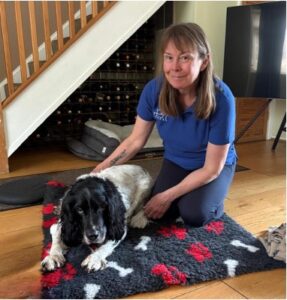
Su Clark is a member of the Canine Massage Guild. She runs Su Clark Clinical Canine Massage, based in Twickenham covering South West & West London, Middlesex and North Surrey.
You can find out more about Su at suclark.com
About the Canine Massage Guild
The Canine Massage Guild is a network of highly skilled Clinical Canine Massage Therapists based around the UK, Ireland and overseas. We specialise in soft tissue rehabilitation and provide chronic pain management for orthopaedic conditions.
In clinical trials with Winchester University, which studied the efficacy of the Lenton Method®, 95% of dogs responded positively to Clinical Canine Massage therapy. As published in ‘Vet Record’ by the British Veterinary Association.
Providing results you can see and your dog can feel!
Find your local Canine Massage Guild therapist: www.k9-massageguild.co.uk/therapistregister/