I have always had a love of the greyhound and sighthound – those needle noses and long limbs, lean, muscular bodies and an aloofness that just draws you in!
A greyhound carries 55% of their bodyweight in muscle (compared to 45% in other breeds) and here are some important anatomical and physiological points to consider:
- Two thirds of the body is carried on the front limbs, one third on the hind limbs. This forward gravity effect aids acceleration.
- Muscles on the hind limb are larger and thus produce more power and strength.
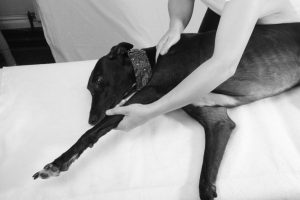
- The forelimbs have 80% steering function, 20% speed, with an important weight bearing and shock absorbing function.
- Most limb extension is immediately prior to weight bearing, most flexion when the limb is in the air. Therefore the extensor muscles are stronger than flexor.
- In addition to flexors and extensors, abductors and adductors contribute to limb movement, a complex interaction of a number of different muscles.
Factors influencing injury in a Racing Greyhound:
- Speed into the bend. Some, especially young greyhounds, are so fast during the 80-100metre race to the first bend and are forced to either check or collide with other greyhounds.
- Structure of the track. The average track has two long straights of 80-100 metres and two bends, making a total circuit of 380-500 metres.
- The track surface. Is the going soft, good, hard?
- Hormonal factors affecting bitches. During the 11 weeks after a bitch has been in season, progesterone and prolactin rise in the blood stream even if no mating has occurred. This can affect collagen in tendons and ligaments. Traditionally they are rested during their season and for the following 11 weeks but there is a marked incidence of lameness in bitches returning to race.
- Training.
Common Orthopaedic Injuries
Toes and feet. Torn collateral ligaments; sub luxations (dislocation) and fractures of metacarpals/metatarsals; injured superficial digital flexor tendons.
The carpal (wrist) joint. Injury to the wrist is the most common cause of early retirement. The most common fracture is that of the right accessory carpal bone. Arthritis is a common sequel to wrist injuries.
The hock. The hock is made up of 7 bones and fracture of the central tarsal (usually in the right hock) is often accompanied by fracture of one or more of the other bones.
Muscle injuries
Neck and forelimb. Brachiocephalicus (action – to advance the limb, extend the shoulder joint and draw the neck and head to the side), Supraspinatus (extends shoulder), Infraspinatus (to extend or flex the shoulder, abduct and rotate the shoulder laterally), Deltoid (flexes and abducts the shoulder), Triceps (extends elbow), Biceps brachii (flexes elbow).
Hind limb. Biceps femoris (extends the hip), Semitendinosus (extends the hip), Middle Gluteal (extends the hip and abducts the hip), Pectineus (adducts the hip), Gracilis (adducts the hip and extends the hock – the ‘0 to 60 mph muscle’), Tensor Fascia Lata (flexes and stabilizes the hip and extends the stifle), Quadriceps femoris (extends the stifle), Gastrocnemius (extends the tarsus and flexes the stifle).
Fascia injuries. Fascia can ‘pop’. When a dog is static, fascia takes on the shape of that position; when there is a sudden explosive action, the fascia hasn’t time to change with the sudden movement.
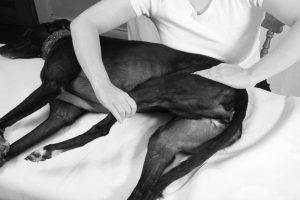
Rehomed Greyhounds
When a racing greyhound retires, the lucky ones get re homed into a domestic environment and their activities of daily living change enormously. They are now able to wander freely around the house/garden, go up and down stairs, on and off the sofa, walk for longer on a regular basis and whatever else you choose to do with them! Therefore the dog will be coping with not only old injuries from their racing life, but also new accumulated injuries from their new home environment!
How to prevent further injuries:
- Look at their new environment and make it as easy as possible e.g. Raised Feeders.
- Place rugs on Laminates and wooden flooring.
- When training don’t force your dog to do something they are uncomfortable e.g. many greyhounds are reluctant to sit due to the length of the spine.
- Correct Bedding e.g. Flat and padded – NOT curved plastic basket.
- Check their food supplementation. They should be starting a glucosamine supplement now in addition to Omega 3 Oil to help with skin and coat.
- Hydtration– when being kennelled many dogs don’t have full access to water but encouraging them to drink more or adding water to their food will help hydrate their muscles and fascia which can help to reduce stiffness.
- Appropriate exercise – NEVER let your greyhound run without warming them up first as this is one of the primary reasons why previously injured muscles re-tear – muscle being more prone to injury when it’s cold.
- Attend a Canine Massage workshop and learn how to improve your dog’s comfort levels at home – see k9massage.co.uk
- Book Your Dog’s Appointment with a Guild Member Canine Massage Therapist today!
Author: Helen Clarke
For more information please visit Helen Clarke’s biography.