I first met Bosley in 2019 when I was training to become a Clinical Canine Massage therapist. He was, and still is one of the sweetest, calmest Springer Spaniels I’ve ever met. After passing the course, Bosley’s owners got in touch to ask if I could treat him again, as he had a recent suspected Vestibular episode.
Reasons for seeking Massage
Bosley was now 13 years old, and the Vestibular episode had caused him to become quite unsteady on his feet and much stiffer when walking.
Due to struggling on walks, Bosley was taken out in a buggy – a much safer choice for him. Bosley already had bilateral hip pain and associated muscle pain which had become noticeably worse since he started losing his balance as his muscles had started to weaken.
After having such good results previously, we hoped to achieve something similar this time. Bosley’s owners knew that we would be unable to ‘fix’ everything; our hopes were to make him more comfortable and more mobile so that he could enjoy his walks again.
What did I find?
When I met Bosley, he wore a harness which helped his owners to guide him around the house and to pick him up if he had a fall. Bosley was unsteady when walking and struggled with his balance. After palpating (a hands-on assessment of the muscles) I found;
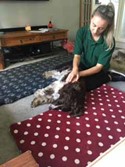
• Myofascial pain to Bosley’s foreleg flexors, his hind limb extensors and his Quadriceps.
Myofascial pain can seem like arthritis. It causes pain, stiffness and can affect mobility.
• Hypertonicity to the Gluteals and Cleidocervicalis
Hypertonicity describes a muscle with too much resting tone. The muscle becomes inflexible and hard which prevents it from being able to lengthen and contract effectively and so prevents normal movement. It can cause a change in posture, for Bosley this meant he was struggling with his neck carriage and was dropping his pelvis.
Working with Bosley
Bosley was very settled throughout his treatments, he would let me know if the pressure was too much or if areas were just too sore that day. During the first session, Bosley needed to take breaks and have a short walk around. This is completely normal and I like the dog to lead the session to enable us to develop a bond. Throughout my training with The Canine Massage Therapy Centre, I have learned different ways to use my skills so that I can treat a dog sitting, standing or lying down. For Bosley, the session would begin with him in a sit and when he was ready he would lie down and rest his head.
I addressed the areas of Myofascial pain using the Lenton Method ® of 7 Direct Myofascial Release Protocols. These were very effective in reducing the Myofascial pain and bringing back normal movement to the muscles.
Swedish massage techniques were used to reduce the hypertonicity. These techniques are also a good way to help a dog to relax and warm up the muscles before any release work.
The results of Clinical Canine Massage
After three treatments over a three-week period, Bosley had really improved. He no longer needed to wear a harness in the house as he was much steadier when walking. He walked around wagging his tail and appeared much brighter when I arrived.
The myofascial pain had reduced and he was no longer showing signs of discomfort during treatments. Bosley was now enjoying his walks again! The buggy was there if he needed it, but he was able to go for short walks without needing to take a break. Bosley’s owners were avoiding any uneven surfaces and found that he preferred to walk on softer surfaces.
The hypertonic muscles had responded very well to massage. They no longer felt hard and inflexible, but instead were much more supple and flexible. Bosley was able to stand with a much better posture, his neck carriage had improved and he wasn’t dropping his pelvis.
What did his owners think?
 “Our old Springer Spaniel is now 13 and has had a couple of mini strokes recently. These affected his balance, which is improving, but he now also has very stiff joints, which hasn’t helped. He was one of Jessica’s case studies when she was learning and he benefitted back then, so we called her and booked a massage to see how he would react following his illness.
We didn’t walk him the following day based on Jessica’s after-care advice, so when we did next go for a walk, the results were really wonderful to see! We always take his buggy out now, as he can’t walk far, but he walked with a spring in his step.
We’ve now decided to ask Jessica to have him as one of her regulars and massage him every month. He’s been such a wonderful dog all his life, a great family dog, it’s the least he deserves”.
About the Author
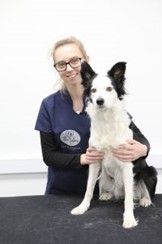 Jessica Heathcote is a member of the Canine Massage Guild. She runs Three Shires Canine Massage Therapy, based in Cheshire. Find out more at www.threeshirescaninemassage.co.uk
About the Canine Massage Guild
 After 10 years the Canine Massage Guild continues to lead the way, with a network of highly skilled Clinical Canine Massage Therapists, based around the country. We specialise in soft tissue injury rehabilitation and provide chronic pain management for orthopaedic conditions.
In clinical trials with Winchester University, which considered the efficacy of the Lenton Method ® of canine massage, 95% of dogs responded positively to clinical canine massage therapy. As published in ‘Vet Record’ by the British Veterinary Association.
Providing results you can see and your dog can feel!
Find your local Canine Massage Guild therapist: www.k9-massageguild.co.uk/therapistregister/