Photo courtesy of Martin Wagenius
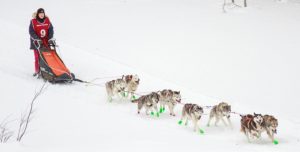
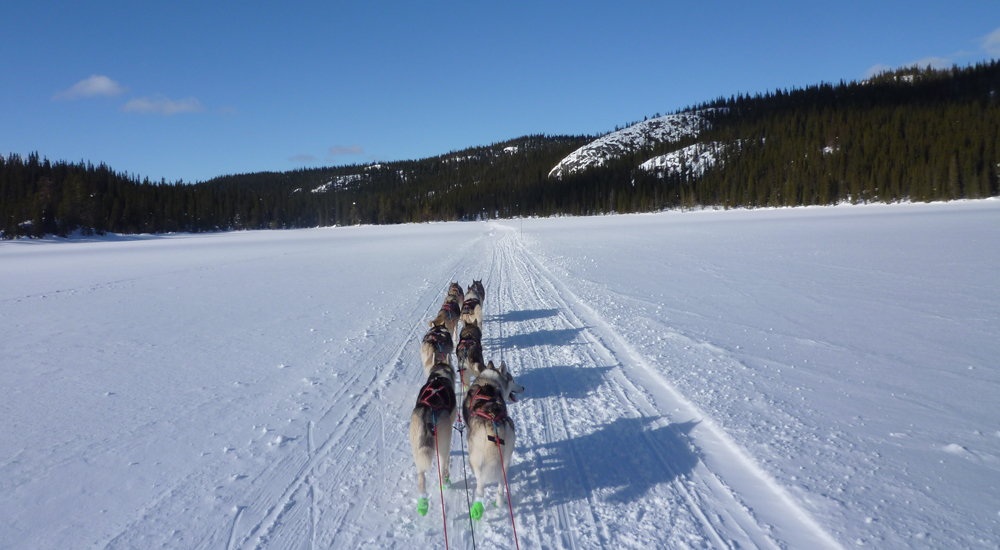
Traditionally, sled dogs were mainly used due to necessity. They were (and still are in some rural communities) often the only way to transport supplies into remote areas. Nowadays, sled dogs are more commonly used for recreation and racing. Sled dog sports vary enormously and many different breeds participate. For dryland, options include 3 or 4-wheeled rigs, quads, scooters, bicycles and your own 2 feet. On snow, options include a sled, pulka or cross-country skis. Races themselves vary enormously and are mostly dictated by climate. Distances vary from short, sprint distances through to the slower mid and long-distances. Mid and long-distance sled dogs have an enormous aerobic capacity and the ability to alter their metabolism allowing them to burn fat directly. The ultimate athlete, once conditioned, possesses a unique type of endurance. These longer distances are only run in colder climates such as Northern Scandinavia, Alaska and Canada. This blog is relevant for sled dogs running either recreationally or competitively, at any level and over any distance.
What causes injuries and muscular issues in sled dogs?
All sled dogs need a lot of training in order to develop both physical and mental stamina. This takes time and repetition, meaning muscular issues and injuries frequently occur. However, certain things can increase the risk, particularly of injury, such as:
- Running too fast on stony, slippery, uneven, icy, rock hard, rutted or abrasive ground.
- Failing to keep the lines tight. The faster you run, the more important this becomes, particularly running downhill. A dog ‘backing off’ is more vulnerable to injury. Slack lines can lead to tangles which can cause anything from losing time to a very serious injury.
- Using an incorrectly fitted harness. The harness should not obstruct breathing, nor should it restrict movement in any way. Note that some shoulder style harnesses have no padding under the point where the tug-line attaches. If your attachment is via a metal clip, this can bang on the dogs back if the line is not kept tight.
- Not using a shock absorber (bungee).
- Always running a dog on the same side of the gang line, this can lead to them becoming ‘one-sided’.
- Conformational weaknesses or orthopaedic conditions such as arthritis: The dog will use their muscles to compensate making them more vulnerable to injury.
- Attending a race with insufficient training, or no training at all (it happens!).
- Lack of foot care.
- Lack of warm-up, and, even more importantly, lack of cool-down before putting your dog(s) back in the van. If the drive to your training area isn’t too long, a warm-up can be done prior to travel and still be beneficial. This is often useful with bigger teams.
What are the most commonly injured areas in sled dogs?
Considering that at least 60% of the dog’s weight (when standing) is carried by the thoracic (front) limbs, it is no surprise that the 2 (or 3!) most commonly injured areas are here.
The Shoulder
The shoulder or humeral joint involves articulation between the Scapula and the Humerus, it is a ball and socket joint. The Scapula (shoulder blade) is a flat, triangular shaped bone which provides support for the shoulder. It is necessary for all movement of the thoracic limb as well as helping to prevent lateral movement when bearing weight. It is also involved in the lateral flexion of the neck. The Scapula has no conventional articulation point to join it to the axial skeleton (trunk) of the dog: the only means of attachment is by muscle. A group of ‘shoulder girdle’ muscles are responsible for attachment, stability and movement making them vulnerable to injury.
The Carpus
The Carpal (wrist) joint comprises of 7 small irregular Carpal bones arranged in a complex set of 3 joints within fibrously reinforced capsules arranged in 2 rows. It is situated between the Radius & Ulna and the Metacarpal bones. One of the main functions of the Carpus is to absorb shock thus protecting the limb as well as supporting it. Providing attachment points for some of the forearm muscles, the Carpus also aids in movement. Repetitive high impact to this joint can result in swelling due to the increased production of inflammatory joint fluid. Sled dogs can often be seen wearing ‘wrist-wraps’ when they are resting at check-points on races. The equivalent joint in the Pelvic limb is the Tarsus (hock) joint which is situated between the Tibia & Fibula and the Metatarsals.
The Paws
No foot, no dog! Distal to the Metacarpals / Metatarsals are the bones of the paws, the 5 Phalanges (the digits or toes). The 4 main digits are numbers 2 to 5 and contain 3 Phalanges. The 1st digit is commonly known as the dewclaw and contrary to popular belief, this digit IS attached by bone in the forepaw: although it only has 2 Phalanges. In the hindpaw, the 1st digit is normally absent but when present, it varies from vestigial to fully formed. The most distal Phalanx in each digit forms the bony part of the claw. There are also several Sesamoid bones and many of the bones provide attachment points for various muscles. Paw injuries are relatively common. Examples include split pads, fissures, keratinization defects (may be liked to zinc deficiency), lacerations, blisters, abrasions, sprains, ruptured tendons (dropped toes), auto-immune conditions, nail damage and nail bed infections. Any injury to the paw will have a knock-on effect throughout the body as the dog tries to compensate. Booties are a very simple and inexpensive way to help prevent paw injuries, particularly when running on snow. Top tip: Kinesiology tape is a very effective way of preventing dew-claw rub under booties.

Photo is courtesy of Carol Spicer
What soft tissue injuries and issues are common in sled dogs?
Muscle Strains
The most common muscular injury, a strain is when the muscle fibres (or tendon, which joins the muscle to the bone) are torn to some degree due to overstretching or overloading. A strain can be chronic, due to repetitive activities, or acute, which can be caused by things like slipping or suddenly changing direction. Strains vary in severity from grade 1 (mild) through to grade 2 (moderate) to grade 3 (severe, requires surgery). After a period of inflammation, the body repairs a strain by laying down scar tissue. Scar tissue is vulnerable to re-strain and reduces the flexibility of the muscle by up to 50%. Commonly affected muscles in sled dogs include the Superficial Pectorals, Infraspinatus, External Abdominal Obliques, Lumbar Epaxial muscles, Gluteal and Gracilis muscles.
Tendonitis
Tendons join muscle to bone and are incredibly strong being able to resist a great deal of tension. However, overuse through repetition or a sudden, sharp movement can lead to inflammation, pain and swelling. When this occurs, it is known as tendonitis or tendinopathy. The most commonly affected in sled dogs are the Biceps Brachii and Achilles tendons.
Muscular Issues
- Trigger Points. A band of taught fibres within a muscle, commonly referred to as a knot. Can cause debilitating levels of pain and lead to ‘fake fatigue’ in the muscle.
- Hypertonicity. Too much resting tone in the muscle fibres, the muscle is unable to relax and thus more vulnerable to injury. A hypertonic muscle may or may not be tight.
- Tight muscle. A ‘sick’ muscle. One which is held in an abnormally shortened state and also more vulnerable to injury. It may or may not be hypertonic.
- Myofascial pain syndrome. Fascia is the environment in which the nervous system lives. It is continuous throughout the body, like a giant web, encompassing all the internal organs, bones, muscles and skin. Fascia can become dysfunctional for many reasons such as injury, surgical procedures, repetitive activities, dehydration, emotional trauma, conformational weakness, orthopaedic/neurological conditions and daily activities. It can also stick to itself and other structures, this is known as adhesion. Interestingly, Myofascial pain in certain muscles can mimic the symptoms of Cruciate Ligament injuries.
- Delayed Onset Muscle Soreness (DOMS). Occurs after exercising when the muscle has been contracting eccentrically. Eccentric contraction is when a muscle is contracting whilst it is lengthening, for example, when ‘braking’ or controlling the lengthening of the muscle. Also likely to be involved in DOMS is acidosis, metabolic waste in the muscle cells.
Ligament Sprains
Ligaments join bone to bone and whilst they are very strong with a small degree of flexibility, they can be stretched too far or torn which is known as a sprain. Sprains vary in severity from a 1st degree (overstretch / very minor tear), through to 2nd degree (partial tear) to 3rd degree (complete rupture) and finally 4th degree (complete rupture taking bone with it). In sled dogs, the most commonly affected joints are the Carpus and Tarsus.
How do I know if my sled dog has a muscular injury or issue?

Photo is courtesy of Chris Wellstead
Sled dogs have an incredibly strong desire to run and mask discomfort very well! This was actually my inspiration for training as a therapist. I have trained and raced my own Siberian Huskies in both sprint distance (in the UK) and mid-distance (in Sweden). The Canine Massage Guild has produced a wonderful aid called The 5 Principles of Pain which can be found here. The 5 principles are: Changes in Gait, Posture, Behaviour, Activities of Daily Living and Performance. Changes in any of these can be indicative of muscular injury or issue.
Gait changes commonly associated with sled dogs are pacing and crabbing. The structure and proportions of the dog directly influence their tendency to pace or crab. A lack of balanced angulation (particularly when there is more angulation in the rear) and/or a short body length can result in interference between the rear and forelegs, known as overreaching. By travelling with the legs moving on a different plane (crabbing) or moving the legs in lateral pairs (pacing) rather than diagonal pairs (trotting) the dog can avoid interference. Over mid and long distances, sled dogs will sometimes pace to conserve energy and/or rest muscles, and they might pace if the speed of travel is a little slow for them to comfortably trot. In addition, pacing can sometimes be seen in dogs with a diagnosable Orthopaedic condition. It’s important to note however, that both pacing and crabbing can be caused by a muscular issue and can even become habitual.
Why use Clinical Canine Massage for your sled dog?
 I’ve yet to read any good book on training sled dogs which doesn’t speak about the importance of massage. Massage can help all sled dogs maintain muscular health, whether you run them for fun or at the highest levels of competition. It can also be really beneficial for retired sled dogs too: it’s never too late for them to reap the benefits. Having your sled dog seen by a Canine Massage Guild therapist is quite simply one of the best things you can do for them.
Clinical Canine Massage directly addresses tight, hypertonic and sore muscles. It is a safe and highly effective way to release trigger points and often resolves what’s causing them in the first place. It helps to break down restrictive scar tissue, restoring flexibility to affected muscles. We use over 50 different techniques encompassing Swedish, Sports and Deep Tissue massage as well as incorporating safe stretching. Unique to us is ‘The Lenton Method™’ where we use advanced palpation and body mapping to identify any issues before using direct myofascial release techniques called ‘The 7 Protocols’. By addressing large areas of fascia in this manner we improve the range of movement in joints whilst also reducing acute and chronic pain. Your therapist will assess and treat your whole dog, including their toes! This is essential as sled dogs in particular are very good at hiding discomfort and without assessing and treating the whole body, affected areas can be missed.
Massage also enhances venous return, removes lactic acid, influences the flow of lymph, aids the removal of metabolic waste and speeds up natural healing. In addition, your therapist will show you some simple, safe, yet very effective techniques you can use yourself on your own dogs. Results are typically seen in 1-3 sessions and maintenance sessions 2 or 3 times a year can help ensure your sled dog is working comfortably and to the very best of their ability.

Could your dog benefit from massage?
Why not book them in for their own free Muscular Health Check?
To find out more about Suzanne Alexander and Highland Clinical Canine Massage click here.
To find your nearest therapist visit the therapist register.