Clinical Canine Massage has been around for a number of years. However, in recent years, it has increased in popularity, with therapists appearing all over the UK & Ireland (as well as across the world). So how do you, as an owner, decide who will be best for your dog when choosing your Canine Massage Therapist?
Whilst carrying out research for this article I have come across a variety of training organisations, with a huge degree of difference in price, length, content and practical experience.
These range from a £190 purely on-line programme, whereby you submit short answers, write lists, answer quizzes and some essays. Through to 2 year programmes with theory, (some in essay format and some in short answer format) and practical training (some more extensive than others) for £4000+. All of the training I researched enabled the participant to set up in business and work on dogs!
To become a competent Canine Massage Therapist takes time to learn, understand, assimilate and master the skills. If someone has completed a day / weekend course then ask yourself “Would I be confident putting my dog into the hands of someone who has done an 8 – 16 hour course or someone who knows the theory but not touched a dog?” Oh and not forgetting that you will be paying for them to work on your dog!
To assist you in selecting the most appropriate therapist, below is a checklist of things that you should check before engaging with a canine massage therapist.
Vet consent
The first thing you should be looking for is someone who will only work on your dog after obtaining vet consent. This should be from a vet that knows your dog and its history. Please don’t let someone at a show or event allow a vet that is connected to them sign the form and then have work done on your dog.
As complementary therapists we must respect the Veterinary Surgeons Act 1966 & the Exemption Order 2015 by never working on an animal without their prior approval / permission, which must be obtained in writing.
Comprehensive training
For a therapist to have the appropriate knowledge, skills and behaviours to work competently and confidently on your dog then they must undertake a combination of theory and practical training by a suitably “competent” organisation. Also ensure they adhere to appropriate occupational standards. This training should cover the following as a minimum:
Theory
- Anatomy & Physiology – of a dog (skeletal, muscular, lymphatic system)
- Origins, insertions, actions and fibre directions
- Canine Kinesiology
- Massage and the law
- Nervous and vascular systems
- Orthopaedic conditions
- Contraindications
- Business skills
Practical
- Hands on with ‘real’ dogs, who are experiencing muscular and / or orthopaedic issues
- Palpation of muscles and identifying strains, muscular injuries and dysfunction
- Fascial imbalance
- Variety of massage disciplines (such as Swedish, Sports, Deep Tissue, Myofascial Release
- Consultations with owners
- Case studies with ‘real’ dogs and their owners
A training organisation may offer a ‘Diploma’ however, with changes in the law, anyone can deliver a programme with the word Diploma, whether they have practical experience or not. The relevant training organisation should have their programme accredited by a reputable ‘awarding body’. There is no harm in doing a search on the training organisation and awarding body if you want to find out more.
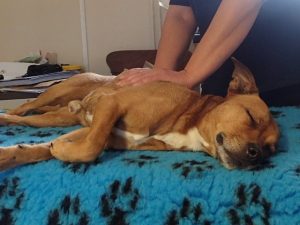
A Clinical Canine Massage Therapist, who has been trained by the Canine Massage Therapy Centre (CMTC), will have undertaken over 1200 hours study. Completing 11 written modules, which are written to degree level. Each module requires approx. 5,000 to 10,000 words to be able to fully answer each assignment. Nine of these must be completed within their first year. Students cannot commence practical sessions in year 2 without these being first completed. This ensures that the student has the appropriate theoretical knowledge before commencing practical sessions.
There are then 12 practical, face to face days, whereby the massage techniques are taught, along with reinforcing the theoretical knowledge. Students learn not only Swedish massage, but also Remedial Sports, Deep Tissue and Myofascial release (both direct and indirect). We also learn the Lenton Method™, Body Mapping and Advanced Palpation techniques. All of which are unique to therapists taught through by CMTC. Assessment is continual throughout the theoretical element, the face to face workshops and the 10 case studies, which are undertaken on dogs in the student’s local area.
Pricing
Please be cautious of therapists offering ‘block bookings’. I saw one that stated ‘buy 5, get the 6th free’. Canine Massage Guild members work on the principle that, due to the techniques we use, we will see results within 1-3 sessions or we refer back to the vet, and therefore the need to purchase blocks of sessions is unnecessary.
Prices vary hugely. Our aim is to make canine massage affordable and the majority of prices should be in the range of £35-£45 for a session.
Ongoing knowledge & skill development
To ensure that your therapist stays current and fresh then check to see what they are doing to complete Continuous Professional Development (CPD). As a Canine Massage Guild therapist (our professional association), members must complete a minimum of 25 hours CPD each year. Audits are conducted annually to check this is undertaken. If someone has completed a massage course 5 years ago and not kept their skills and knowledge up to date then this should ring some alarm bells for you.
Other considerations when choosing your Canine Massage Therapist
Please be mindful of being swayed by people with “letters” after their name. I can have the following letters after my name:- BSc Hons, MCIPD, MNLP etc. However this just means I have passed theoretical exams, not necessarily got practical, real life experience (and none may be related to dogs or massage!).
All therapists should have comprehensive insurance and be more than happy to share this with you.
Also, a report should be completed and sent to your vet after the initial set of sessions. This report relays what has been found and what work they have completed. This demonstrates respect for your vet and ensures they are kept informed of what soft tissue issues have been found. Many vets will admit they are not soft tissue specialists and this is very helpful information for them.
In summary
So you will see, there is huge benefit in researching and choosing your Canine Massage Therapist carefully. By selecting a Canine Massage Guild therapist you know what you are getting. We have received high quality, thorough training. We are also the only Canine Massage Therapy organisation in the world that is undertaking clinical trials. These trials are assessing the methods we use and demonstrate scientific evidence that our techniques work. Though many, many dogs and owners will already attest to how amazing our work is in helping them!
To find your local Canine Massage Guild therapist, go to www.k9-massageguild.co.uk/therapistregister/