
Do you prefer picnics or formal dining? Beanbags, sofas or upright armchairs? It’s all a matter of what makes us feel most comfortable. When it comes to Clinical Canine Massage Therapy, dogs are no different. Lisa Stilwell explains more:
As a Clinical Canine Massage Therapist, I work with dogs of all ages and types from pets to show dogs, working dogs and canine athletes. They come in a huge variety of shapes and sizes. I’ve had days where I go from treating a Chihuahua in the morning, a Samoyed at lunchtime and then a Neapolitan Mastiff in the evening.
Massage table versus floor – Getting the best outcome
The environment where treatment takes place is very important. I do what I can to ensure the space is calm and the correct temperature. One of the biggest considerations is where treatment should take place – massage table versus floor or sometimes somewhere else.
Firstly, there are some Health and Safety considerations when deciding on the location of treatment. Some of the larger dogs that I see are too large for me to lift safely, so they will always be treated on the floor. Equally, if I have a client who lives in a block of flats without a lift, it is unlikely that I will be able to carry my table up flights of stairs without risking injury.
Each dog is an individual and deciding where treatment should take place is discussed with the owner at the first appointment. I mostly treat dogs on either the floor or a massage table, but have also treated dogs on sofas, in their beds or even on garden furniture, if that is where they are most comfortable.
Dog’s perspective – Beryl and Brian
When considering massage table versus floor, I try to see things from the dog’s perspective. How would it feel for a Jack Russell Terrier to have someone towering over them? Equally, how would it feel to a senior, arthritic Labrador to be lifted on and off a table?
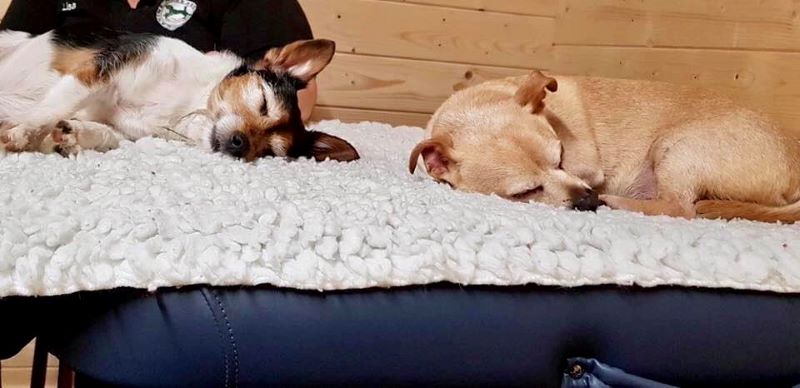
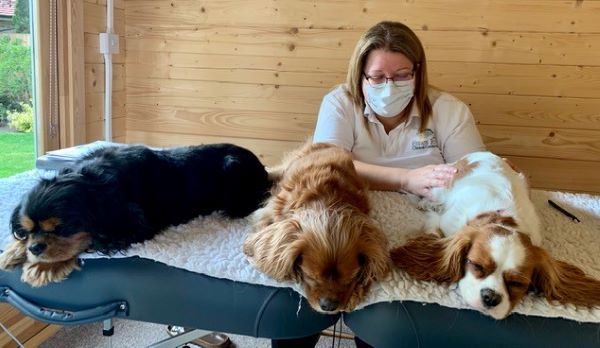
Beryl and Brian are two of my regular clients. They are normally very excited to arrive at the clinic, running up and giving me the most amazing greeting. After a few seconds they are off and run straight into the clinic. By the time I catch up with them they are at the table, jumping up excitedly in anticipation of being lifted up for treatment to begin.
They love being up on a massage table and often sit up there together during treatment.
 In contrast, Tikaani always prefers to have his treatment on the floor. He’s a larger dog and being on a table doesn’t feel comfortable for him, so we opt for treatment where he feels happiest.
But, whether on the table or the floor, my number one priority is to ensure that the dogs in my care are as happy and settled as possible throughout treatment. If a dog is feeling content and safe, then ultimately a better outcome for the treatment will result.
Owner Perspective – Micheline Rawley with Rufus, Copper and Indi
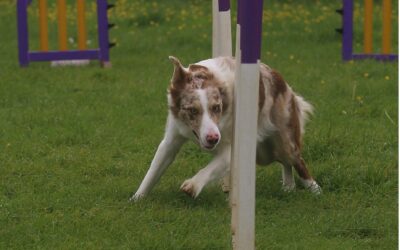
I have three agility dogs who have regular Clinical Canine Massage. It is great that all three dogs, including one who is very nervous, react so positively to the treatment.
At the first appointment, Lisa allowed us to experiment using both the floor and table so we could see which each dog preferred. All three settled better on the table.

I think this is possibly because being small dogs they are happier without someone towering over them. Of course, the fact that most other professionals, including vets, tend to treat small animals on a table, means it is something they are used to.
By the end of a session all the dogs are very relaxed, which is no mean feat for my nervous little one!
I am always impressed that their therapist is concerned, not only with improving the dogs’ wellbeing, but making sure at all times they are happy and content with whatever she is doing with them.
By Lisa Stilwell of Essex Rivers Clinical Canine Massage. Member of the Canine Massage Guild and University Clinical Trials Co-Ordinator
To find your local Canine Massage Guild therapist, go to www.k9-massageguild.co.uk/therapistregister/