Simple and comprehensive, focussing on gait, posture, activities of daily living, behaviour and performance, the Canine Massage Guild ‘5 Principles of Pain’ chart helps you identify symptoms in your dog that may respond well to clinical canine massage therapy.
Here, Guild therapist, Karen Tregaskis explores the principle of behaviour more deeply, detailing exactly what we need to look for and explaining just why behavioural signs can sometimes be tricky to spot and confusing to interpret.
A physically healthy dog should equate to a confident outgoing behaviour
Caroline Ingraham, 2017
How dogs communicate
While your gran can tell you that she’s not feeling herself because of aches and ailments we can’t see, our dogs are unable to explain verbally when and where it hurts.
However, if we just open our eyes to the endless choreography of communication that is the body language of dogs, we can learn what to look out for and not leave our best friends to suffer in silence. While acute pain due to trauma can be indicated by sudden vocalisation, limping, or symptoms of shock such as an inability to move, enlarged pupils and loss of appetite, chronic pain doesn’t throw up such obvious red flags.
Observing our dog’s activities and how they go about their normal day is key to recognising when something has altered that gives rise to a change in behaviour. Behavioural changes and issues are frequently associated with dogs holding onto discomfort and pain. Dogs that become ‘grumpy’, ‘snappy’ or antisocial, demonstrating behavioural displays of fear and anxiety, are too often dogs coping with pain.
What causes chronic pain?
Chronic pain issues may arise months or even years following a known injury or surgery, leaving us puzzling over what has happened to our dog. Age-related joint wear and tear giving rise to arthritic conditions is a more obvious cause, but things dogs do every day, without us even thinking about it, (activities of daily living) can have a massive impact on their long-term wellbeing.
The accumulation and repetition of an activity, such as pulling on a collar and lead, can result in dysfunctional soft tissue and joint pain. In this example, the soft tissue in the neck and shoulder girdle are directly affected and cannot function normally. Other areas of the body work harder in compensation. There are muscles running the entire length of a dog’s back, so it’s no wonder that continual pressure on the neck region can potentially affect this entire area.
Without due care given to a puppy’s early experiences, joint wear and tear may begin as a young dog, particularly one that has repeatedly overdone an activity such as jumping or sliding and twisting to catch a thrown object.
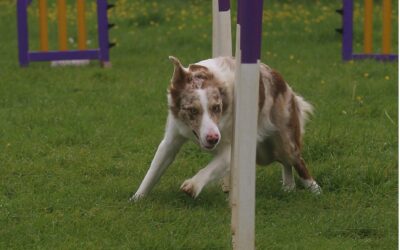
Home and garden can be another source of physical stress: sliding on mud, wet grass, sand, a laminate floor all take their toll on a dog’s joints. Working dogs, by this I mean agility, flyball, canicross, search and rescue dogs as well as gundogs, also have daily or intermittent stresses placed on their body in the name of performance.

Activities of daily living
When any of the following change noticeably, it is time to look further:
- Sleeping: inability to sleep or increased sleeping. Restlessness can signify an inability to relax or get comfortable. We know that dogs can sleep a lot, especially as they age, but understand what is normal for your dog. Increased sleeping can be a way of shutting off from pain or stress
- Eating habits: inability to stand and eat
- Getting in and out of the car: inability or reluctance to jump in or out
- Stairs/steps: inability to go up or down
- Walking, playing: loss of enthusiasm for any stimulation
- Sociability: disengaged with the household – people and dogs
- Hindlimbs: are they getting weaker? Observe how they move, whether they struggle to sit or get up
Fear, anxiety and the link to pain
It is a dog’s priority to feel safe and when they are in discomfort, they will feel more scared and vulnerable. Anxious behaviours that reflect this include:
- Hiding
- Cowering
- Curling up; unresponsive
- Separation anxiety
- Biting
- Restlessness
- Hanging of head
- Excessive barking
Understanding these behaviours requires us to observe how the dog goes about its daily life. How it holds itself, moves around and vocalises. Too often, dogs are ‘diagnosed’ with behavioural problems based on emotional trauma. Crucial signs of undiagnosed conditions are missed. When a dog modifies its behaviour, it can be really subtle. By the time we guardians notice, the dog can be experiencing significant discomfort.
Invisible conditions that can give rise to behavioural changes include:
- Pain
- Neutering complications: adhesions and scar tissue
- Inflammatory issues: musculoskeletal; urinary; gut
- Infection
- Hormonal imbalance
Displacement behaviours and disguise
While it can help to use the watch-lists, it’s the context of the behaviour that is key. Consider the circumstances; individuals involved; the environment; the other physical signals. Admitting weakness is an invitation to bullies and predators. Animals that live in social groups have evolved hard-wired behaviours to conceal pain.
Look out for a dog showing behaviour displacement rather than obvious signs of pain. This is when pain or discomfort may be masked by activities that increase adrenaline which interferes with pain perception. Long term, constant adrenaline-seeking is counter-productive to good health. Compromising the functioning of all the body’s systems. Or, you may notice the canine version of ‘rubbing it better’ by simply stopping the pain signal. Excessive licking of an area does this… until the licking stops.
But remember, context!
Tiredness and stress can be other causes of displacement behaviour. By stress, I mean in the physiological sense. Both excitement and fear have similar effects on the body with hormones being released activating the sympathetic nervous system.

Appeasement behaviours
Dogs may also disguise their pain with appeasement behaviour. This is ‘normal’ behaviours, such as wagging their tail. Just like a human’s smile, a wagging tail isn’t as simple as ‘I’m happy’. In fact, a wagging tail is just a display of a dog with heightened emotions and this might be for many reasons. Look at the rest of his body – are hackles raised? Are his body and mouth tense? Is the tail low and the back rounded? Maybe he is just grinning and bearing it. Always keep context in mind. You’d expect a bedtime yawn and shaking his coat and body after rolling. But you might also feel there is an obsessive, repetitive element to the behaviour.
Here are some more examples:
- Excessive scratching, nibbling (this can quickly escalate to self-mutilation)
- Licking lips
- Excessive or out of context yawning
- Sniffing the ground when there’s nothing to sniff
- Excessive self-grooming
- A body shake all over when not wet or rolled
- Licking – e.g. paws or legs (without irritation initially, the licking can then create inflamed ‘hot spots’)
- Licking – anything at all: person; door; floor
- Gnawing on unsuitable objects
Displacement behaviours may be observed in situations where a dog feels anxious or unsure – for any reason. In wanting to protect themselves from pain or fear or conflict they suppress a desire to do something about the situation.
Other ‘What’s got into him?’ body language
These behaviours are easily overlooked with our busy lives. We might think he’s just sulking or deliberately trying to annoy us by not cooperating with grooming, bathing or doing as we ask. But it’s actually important to think twice about behaviours such as:
- Subtle or extreme signs of being touch-sensitive: flinching, pulling or moving away
- Unduly submissive
- Lacklustre, depressed, withdrawn and unfocussed; inability to acknowledge the human voice
- Appearing vulnerable or suddenly phobic to a stimulus when previously had not been
- Irritability – sudden onset and out of character. Intolerance when touched and to other animals in the house
- Clearly cold and constantly wanting to lie under a radiator or by the fire
- Facial expressions: flattening the ears; excessive blinking or just staring
- Facial muscle tension
Aim to be aware of your dog’s habitual movements and posture. When standing; getting up; sitting; lying; sleeping. And get straight to your vet’s if you notice your dog obviously limping, not fully using a limb or not weight bearing through a limb.
In summary
 I hope this has helped to demystify hidden pain and given you plenty of pointers for picking up the silent signals of discomfort.
If any of these behaviours sound familiar, canine massage could be just what your dog needs. But remember, if you are worried about any behavioural changes in your dog, it’s important to eliminate the possibility of any serious underlying issues by visiting your vet.
By Karen Tregaskis of Canine Symmetry Clinical Massage, based in the Home Counties.
To find your local Canine Massage Guild therapist, go to www.k9-massageguild.co.uk/therapistregister/
Bibliography and references:
2020. [image] Available at: <https://www.youtube.com/watch?v=6oKSgnQxiZ0&feature=share&fbclid=IwAR0EpdbzA1PMydVAwHRr46dYbbCwxT1f-JceXcJtRHSuQj_jU89E9TI8ing> [Accessed 22 November 2020].
(COVID-19), C., Health, E., Disease, H., Disease, L., Management, P., Conditions, S., Problems, S., Disorders, S., Checker, S., Blogs, W., Answers, Q., Guide, I., Doctor, F., A-Z, C., A-Z, S., Drugs, C., Pregnant, T., Medications, M., Identifier, P., Interactions, C., Tool, D., Management, D., Obesity, W., Recipes, F., Exercise, F., Beauty, H., Balance, H., Relationships, S., Care, O., Health, W., Health, M., Well, A., Sleep, H., Teens, H., Pregnant, G., Trimester, F., Trimester, S., Trimester, T., Baby, N., Health, C., Vaccines, C., Kids, R., Cats, H., Dogs, H., Here, G., Now, C., Experts, C., Surfaces?, H., Social Distancing, Q., Blogs, W., Center, N., Pets, H. and Dogs, H., 2020. Heavy Panting In Dogs. [online] WebMD. Available at: <https://pets.webmd.com/dogs/dog-panting-heavily#2> [Accessed 25 November 2020].
G2z.org.au. 2020. Home Page – G2Z. [online] Available at: <https://www.g2z.org.au> [Accessed 25 November 2020].
INGRAHAM, C., 2017. HELP YOUR DOG HEAL ITSELF. Tetbury, Gloucestershire, INGRAHAM TRADING LTD.
PetHelpful – By fellow animal lovers and experts. 2020. Understanding Dog Displacement Behaviors. [online] Available at: <https://pethelpful.com/dogs/Understanding-Dog-Dispacement-Behavior> [Accessed 25 November 2020].
Canine Massage Guild. 2020. What Your Dog’s Behaviour Can Tell You About Pain. [online] Available at: <https://www.k9-massageguild.co.uk/dogs-behaviour-can-tell-pain/> [Accessed 28 November 2020]
Knowles, M., 2020. Dog Body Language – Displacement Behaviour – Silent Conversations. [online] Silent Conversations. Available at: <https://www.silentconversations.com/displacement-behaviour-dogs/> [Accessed 28 November 2020].